Leak Detection Technology in Lanzarote: Why It Makes the Difference
Finding a water leak in Lanzarote is rarely straightforward. Pipes run under concrete terraces, through tiled walls, and deep beneath gardens. Many are decades old and made from materials that behave differently under pressure. Without the right equipment, a leak investigation becomes guesswork, and guesswork means unnecessary destruction of floors, walls, and landscaping before the actual fault is even found. Specialist leak detection technology changes that entirely.
The Right Technology for Every Situation
No single piece of equipment can find every type of leak. A thermal camera is highly effective at detecting a hot water pipe leaking inside a wall, but it cannot locate a buried supply pipe leaking under a concrete path. Tracer gas can pinpoint a leak three metres underground, but it will not show the internal condition of a corroded drain pipe. The reason Canary Detect carries over €80,000 worth of equipment is that every situation demands a different approach, and the team needs the full toolkit to match the method to the problem.
Ground-Penetrating Radar for Underground Pipe Mapping
Ground-penetrating radar (GPR) sends electromagnetic pulses into the ground and interprets the reflections to build a subsurface picture. In Lanzarote, this is particularly useful for mapping the route of plastic and non-metallic pipes, which cannot be traced with a standard electromagnetic locator. Before any underground investigation begins, understanding where the pipes actually run is essential. Many properties here were built with no detailed as-built drawings, meaning the pipe routes are genuinely unknown. GPR gives our technicians a map before any excavation or detection work starts.
Acoustic Correlators for Precise Pipe Leak Location
An acoustic correlator is a step beyond a standard geophone listening device. Two sensors are placed at different points along the pipe, and the correlator analyses the time difference in the leak noise arriving at each sensor. From this, it calculates the mathematical position of the leak along the pipe, typically to within a few centimetres, even when the pipe is buried under a metre of concrete. For longer pipe runs across gardens, driveways, and communal areas, correlation is the most reliable method available for achieving the kind of precision that keeps excavation work small and targeted.
Tracer Gas Detection: Finding Leaks Without Excavation
Tracer gas detection involves pressurising the suspected pipe with a safe mixture of nitrogen and hydrogen gas. This mixture is non-toxic, non-flammable, and lighter than air. Where a leak exists, the gas escapes through the same fault that water is escaping through and rises to the surface. A sensitive probe detects the gas at ground level, pinpointing the leak location without any excavation at all. This is our most commonly used method for buried pipe leaks across Lanzarote, particularly for the underground supply connections that run from the street meter to the property boundary.
Thermal Imaging for Concealed Leaks in Walls and Floors
Our thermal imaging cameras detect temperature differences as small as 0.1 degrees Celsius across a surface. A leaking hot water pipe behind a tiled wall will cool the tiles around the fault point in a characteristic pattern that is invisible to the human eye but clearly visible to the camera. Similarly, cold water leaking beneath a heated floor creates a cold patch that shows up immediately on the thermal image. Thermal imaging is fast, non-invasive, and provides visual evidence that can be photographed and included in insurance reports.
Why Lanzarote Properties Need Specialist Detection Technology
Lanzarote presents a specific set of conditions that make leak detection more complex than on the mainland and make accurate technology more important.
Desalinated Water and Pipe Deterioration
The water supply across the Canary Islands comes from desalination plants. Desalinated water has a different mineral profile to mainland European water, and over years it accelerates corrosion inside older metal pipes. Copper and galvanised iron installations that have been carrying desalinated water for twenty or thirty years are frequently in a much worse internal condition than their external appearance suggests. Leak detection technology helps assess this hidden deterioration, not just the active leak.
Older Build Quality and Hidden Pipework
Properties built in Lanzarote during the 1970s, 1980s, and 1990s were often constructed without detailed plumbing records. Pipes run in unexpected directions, at unexpected depths, through walls that were later tiled over or altered during renovation. Detection technology allows us to find where pipes actually are before any invasive work begins and to locate leaks within those pipes without reference to plans that often do not exist.
Holiday Homes and Long-Term Vacancy
A significant proportion of Lanzarote properties are holiday homes or investment properties that may be unoccupied for months at a time. A slow underground pipe leak during a period of vacancy can result in saturated ground, damage to foundations, and subsidence that is not discovered until the owner returns. Our technology allows us to identify and quantify active leaks quickly, even in properties where the pipework has not been monitored for some time.
How We Combine Technologies on a Single Survey
On most surveys, we use at least two or three technologies together. A typical underground pipe investigation starts with pressure testing to confirm a leak exists and measure its severity. We then use electromagnetic or GPR pipe locating to trace the route of the pipe. Tracer gas or acoustic correlation then narrows the location to a precise point. Where appropriate, a thermal camera checks any above-ground sections. Each technology cross-checks the others, which is why our success rate is as high as it is. A single sensor reading can be ambiguous. Two or three readings from different technologies pointing to the same spot is confirmation.
Technology and Cost: Why Investing in Detection Saves Money
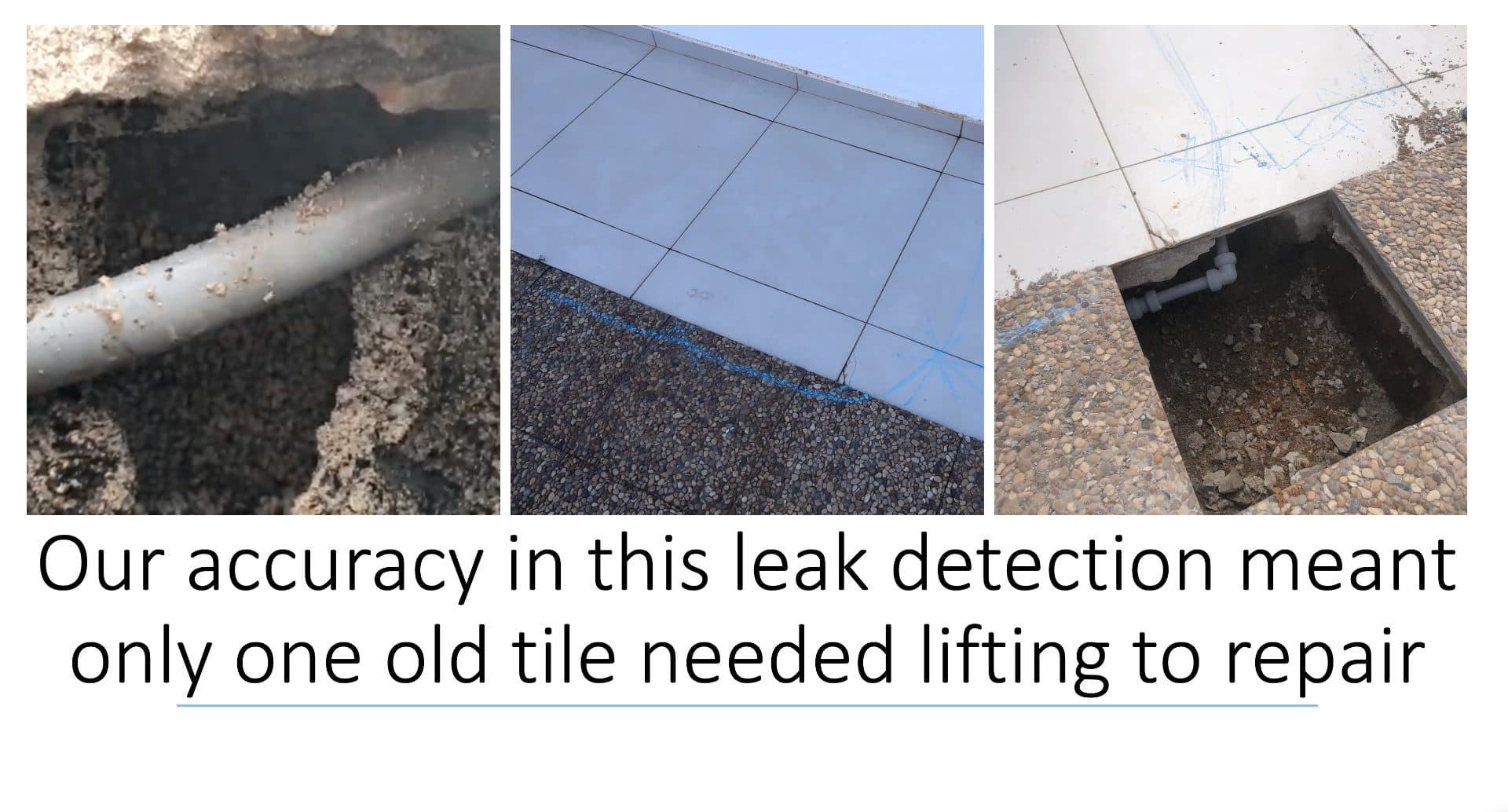
A professional leak detection survey using advanced technology costs a fraction of what unnecessary excavation costs. A contractor who opens up a terrace looking for a leak without prior detection work might lift twenty square metres of tiles, dig through concrete, and still not find the fault. A Canary Detect survey that uses tracer gas and acoustic correlation to pinpoint the leak to within ten centimetres means the repair contractor lifts one tile, digs one small hole, and fixes the pipe. The detection fee is recovered many times over in reduced repair costs, and the property suffers far less collateral damage in the process.
Frequently Asked Questions: Leak Detection Technology Lanzarote
What detection technology does Canary Detect use?
We carry tracer gas detection equipment (GASENSE), acoustic geophones and correlators, infrared thermal imaging cameras, internal pipe microphones, ground-penetrating radar, electromagnetic pipe locators, and full CCTV camera systems for pipe inspection. Each tool is selected based on the specific conditions at your property.
Is leak detection technology safe to use around my family and pets?
Yes. The tracer gas we use is a non-toxic nitrogen and hydrogen mixture. Thermal cameras and acoustic sensors are entirely passive. Ground-penetrating radar uses very low-power electromagnetic pulses that are safe in all domestic environments. None of our detection methods require chemicals, high-voltage equipment, or any procedure that poses a risk to occupants.
How accurate is your leak detection equipment?
In most situations, we can locate a leak to within ten centimetres using acoustic correlation combined with tracer gas. For leaks inside walls, thermal imaging typically narrows the fault area to within twenty to thirty centimetres. Our pipe microphone technology can achieve centimetre accuracy on accessible pipe runs.
Can your technology find leaks under reinforced concrete?
Yes. Tracer gas rises through concrete, tarmac, sand, soil, and most surface materials. Acoustic correlation works through concrete slabs as long as the pipe carries sufficient water pressure. These methods are specifically designed for situations where the pipe is inaccessible without excavation.
Do I need to be present during the survey?
Someone does need to provide access to the property and the water meter. Beyond that, you are welcome to observe the survey or leave our team to work independently. Many of our clients in Lanzarote are property owners who are not on the island at the time, and surveys are often arranged through property managers or keyholders.
What if your technology cannot find the leak?
Our No Find, No Fee policy applies. If we confirm that an active leak exists but cannot precisely locate it using our full range of equipment, you pay nothing for the survey. In practice, this has never happened, but the guarantee is real and unconditional.
How long does a leak detection survey take in Lanzarote?
Most residential surveys take between two and four hours. A straightforward pool leak test can be completed in under two hours. A complex underground investigation across a large property with multiple pipe zones may take a full day. We give you a realistic time estimate when you book, and we never charge extra if the survey takes longer than expected.




 Industry News